As the digital landscape shifts toward containerization and microservices, enterprise integration platforms must evolve. For many organizations, Microsoft BizTalk Server has been the reliable workhorse for decades. However, with mainstream support for BizTalk 2020 ending in 2028 and extended support concluding in 2030, the clock is ticking. Operating on unsupported infrastructure isn’t just a technical debt; it’s a business risk. This necessity has made the BizTalk to TIBCO Platform migration a top priority for IT leaders looking to maintain operational continuity. This guide explores a modern, AI-assisted modernization path to migrate from BizTalk to TIBCOⓇ Platform Integration – BusinessWorks™ (BW) and TIBCOⓇ Platform Integration – BusinessConnect™ Container Edition (BCCE).
Why Migrate Now? The Strategic Shift from BizTalk to TIBCO Platform
While BizTalk often runs on traditional Virtual Machines (on-premises or in Azure), TIBCO Platform’s modern suite is built for a Kubernetes-based environment (AKS, EKS, or GKE). This transition offers:
- Horizontal Scalability: Independent scaling of integration flows as containerized microservices.
- Operational Efficiency: Zero-downtime rolling deployments and Infrastructure-as-Code (IaC) consistency.
- Clear Architectural Boundaries: Separating internal workflows (BWCE) from B2B trading partner communications (BCCE) simplifies troubleshooting.
Mapping the Architecture: BizTalk vs. TIBCO Platform
To ensure a seamless transition, it is critical to map legacy BizTalk components to their cloud-native TIBCO Platform equivalents:
| BizTalk Component | TIBCO Platform Equivalent | Function |
| Orchestrations & Pipelines | TIBCO Platform Integration – BusinessWorks (BWCE) | Core integration engine for routing, transformation, and logic. |
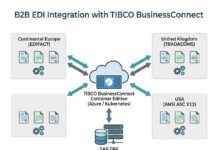
| Party Mgt / EDI / AS2 | TIBCO Platform Integration – BusinessConnect (BCCE) | B2B gateway for X12/EDIFACT translation and secure protocols (AS2, SFTP). |
| Message Box | TIBCOⓇ Platform Messaging – Enterprise Message Service™ (EMS) | The JMS-compliant messaging backbone for reliable asynchronous communication. |
BizTalk to TIBCO Platform – The AI-Assisted Migration Methodology
Manual migration is slow and prone to error. By leveraging AI-powered extraction tools, organizations can significantly reduce documentation timelines.
1. Discovery & AI-Powered Documentation
Instead of manually digging through BizTalk artifacts, custom AI tooling (like Behaim’s MCP servers) parses XLANG orchestrations and pipeline definitions to create “Technical As-Is Documentation”. This ensures dependencies and business rules are captured before a single line of new code is written.
2. Detailed Cloud-Native Design
The AI-generated documentation is transformed into Detail Design Documents. This phase maps BizTalk schemas (XSD) to TIBCO Platform shared resources and defines the EMS queue/topic architecture.
3. Development & Kubernetes Hardening
Integration processes are implemented in BWCE, while BCCE is configured for B2B protocols. A key focus here is hardening the Kubernetes environment with proper network policies and resource quotas to ensure enterprise-grade security.
BizTalk to TIBCO Platform – A Staged Approach to Risk Mitigation
A “big bang” cutover is rarely the right choice for mission-critical B2B integrations. A 6-phase staged migration is recommended:
- Assessment & Planning: Inventory BizTalk assets and design the IaC templates.
- Design & Pilot: Validate the approach with a small-scale proof of concept.
- Build & Test: Full implementation and production Kubernetes setup.
- Trading Partner UAT: Validate EDI exchange and protocols with actual external partners.
- Staged Migration: Production cutover in batches (low-risk partners first) with a 2-4 week soak period between batches.
- Stabilization & Decommissioning: Final side-by-side validation and shutdown of legacy BizTalk VMs.
Conclusion: Future-Proofing Your Integration
Migrating from BizTalk to TIBCO Platform is more than just a platform swap; it is an opportunity to embrace AI-assisted modernization and a containerized future. By following a structured, documentation-driven methodology, organizations can eliminate the risks of end-of-life software while gaining the agility of a modern cloud-native stack.
To learn more about the migration process, please review the full technical brief from TIBCO’s partner, Behaim ITS.
Recognized with four TIBCO Partner Excellence Awards, Behaim ITS is a trusted IT integration and operations partner with 14+ years of experience in enterprise-grade system integration, middleware, and mission-critical IT support. Specializing in TIBCO technologies, we deliver deep expertise across the TIBCO Platform for Integration, Messaging, EDI, Managed File Transfer, and ActiveSpaces.