In the contemporary enterprise landscape, the ability to make rapid, transparent, and accurate decisions is the ultimate competitive differentiator. As organizations navigate digital transformation, separating volatile business logic from procedural code has moved from a luxury to a necessity. The release of TIBCO BusinessEvents 6.4 Enterprise Edition marks a pivotal advancement in this domain, introducing native support for the Decision Model and Notation (DMN) standard.
By integrating DMN into one of the industry’s most robust Complex Event Processing (CEP) platforms, TIBCO BusinessEvents 6.4 empowers enterprises to bridge the gap between business intent and technical execution, creating a unified architecture for real-time intelligence.
The Architecture of the DMN Standard
The DMN standard, established by the Object Management Group (OMG), provides a vendor-neutral framework designed to be readable by business analysts and executable by technical systems. It structures decision-making across three distinct, powerful layers:
- The Visual Layer (Decision Requirements Diagram): At the highest level, the Decision Requirements Diagram (DRD) maps the dependency network of a decision. It visualizes how information flows from Input Data (such as customer profiles or market rates) through various dependencies to reach a final Decision. This visual decomposition allows complex logic to be broken down into manageable, understandable components.
- The Logic Layer (Boxed Expressions): Beneath the diagram lies the logic specification, typically represented as Decision Tables. These tables present business rules in a clear, tabular format, ensuring that logic is unambiguous and easily verifiable by stakeholders.
- The Execution Layer (FEEL): The standard utilizes the Friendly Enough Expression Language (FEEL). Designed to be user-friendly (supporting spaces in variable names) yet mathematically precise, FEEL supports robust data types—including numbers with 34 digits of precision—to ensure accuracy in financial and scientific applications.
TIBCO BusinessEvents 6.4: A Modern Foundation
Released in January 2026, TIBCO BusinessEvents 6.4 is a Long-Term-Support (LTS) release that modernizes the event processing landscape. Beyond decision modeling, this version introduces high-performance enhancements, including support for GraalVM for improved throughput and resource efficiency, and integration with Java 25 to leverage the latest language features.
However, the defining feature of this release is its strategic embrace of the DMN standard, transforming the platform from a pure event processor into a comprehensive decision engine.
Seamless Integration: From Model to Execution
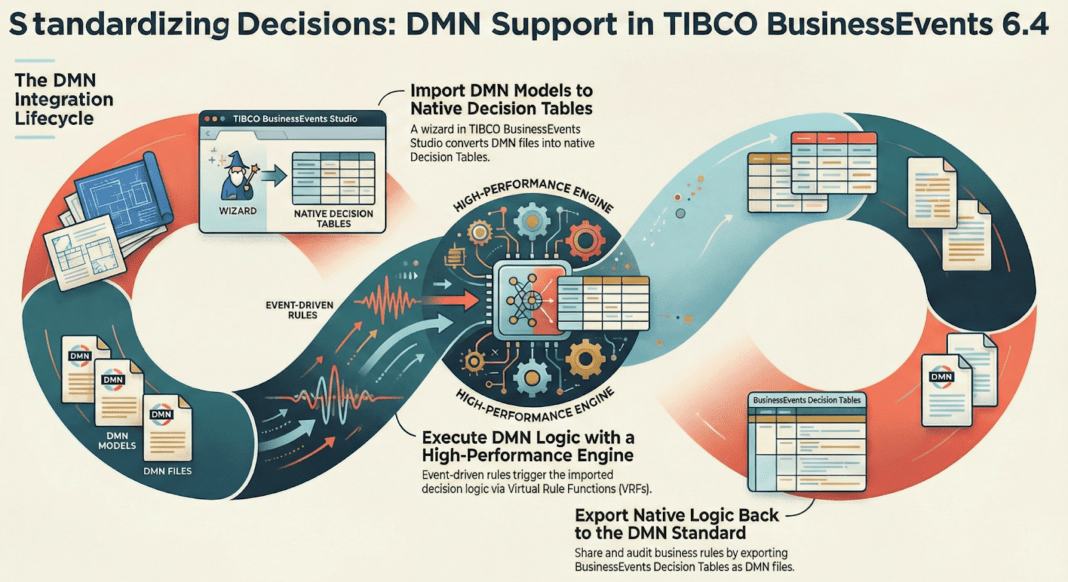
The integration of DMN in TIBCO BusinessEvents 6.4 is designed for seamless bidirectional interchange, allowing organizations to leverage best-of-breed modeling tools while utilizing the high-performance execution engine of BusinessEvents.
- Intelligent Ingestion – The platform features a specialized wizard for importing DMN files. During this ingestion process, the system performs a sophisticated mapping where DMN input and output entries are associated with TIBCO BusinessEvents Concepts or Events. If the required concepts do not exist, the importer automatically generates them based on the DMN model properties, preserving complex data structures and ensuring immediate alignment with the project’s ontology.
- The Power of Virtual Rule Functions (VRF) – The architecture leverages Virtual Rule Functions (VRF) to bridge event triggers and standardized decisions. In this model, a VRF defines the interface (inputs and outputs), while the imported DMN model provides the implementation in the form of a BusinessEvents Decision Table. This allows standard event-processing rules to detect patterns and instantly invoke standardized DMN logic to determine the next best action.
- Ecosystem Interoperability – TIBCO BusinessEvents 6.4 also supports the export of native Decision Tables as DMN files. This capability is vital for the modern open enterprise, enabling organizations to share their logic with other DMN-compliant tools for analysis, auditing, or use across different business units, breaking down proprietary silos.
Elevating the Architecture: Rule Engine vs. Decision Engine
The support for DMN signifies a shift from traditional rule execution to true decision management. While a traditional Business Rules Engine (BRE) is optimized for executing simple “if-then” logic for operational tasks, a Decision Engine leverages standards like DMN to model complex, context-aware decisions involving multiple data points and interdependent sub-decisions.
By adopting DMN, TIBCO BusinessEvents 6.4 effectively combines the strengths of both worlds:
- High-Volume Processing: It retains the speed and stateful correlation capabilities of a CEP engine.
- Strategic Modeling: It gains the adaptive, data-driven modeling capabilities of a Decision Engine, capable of handling complex, context-driven scenarios.
The Synergy with BPM Tools
This release aligns TIBCO BusinessEvents with the process of seamless integration with BPM tools (capable of using BPMN for processes & CMMN for cases). Now, with DMN (for decisions) these tools can encapsulate logic within DMN services and simplify their process models. A BPMN process can delegate complex logic to a specific task that calls a DMN service hosted in BusinessEvents, ensuring that business rules can be updated independently of the process flow.
Conclusion
TIBCO BusinessEvents 6.4 represents a fundamental modernization of the platform, empowering enterprises to operationalize the DMN standard within a high-performance event-driven architecture. By fostering collaboration between business analysts and developers, and by ensuring interoperability through open standards, TIBCO provides the foundation for the next generation of real-time, intelligent, and transparent enterprise decision-making capabilities.
Author:
Suhas Dhekane
Suhas Dhekane is a Senior Principal Solutions Architect with over 18 years of experience at TIBCO, dedicated to bridging the gap between complex technology and tangible business value. Throughout his career, Suhas has led large-scale digital transformation initiatives, helping global enterprises navigate the intricacies of Data and AI. His passion lies in architecting solutions that don’t just solve immediate technical hurdles but drive long-term adoption and measurable success. From Go-To-Market strategies to Professional Services and now defining AI Product Strategies, he thrives on turning complex data challenges into streamlined, high-impact Product features that lead to faster adoption and business outcomes.