Summary
- The problem: Employees lose their sharpest hour every morning reassembling context from Slack, email, calendar, and task lists — and still miss things that matter.
- The solution: An automated AI Morning Briefing built with TIBCO Flogo that gathers those four sources, asks a large language model to prioritize them, and delivers one clean report.
- The output: A three-tier briefing — 🔴 Needs Attention, 🟡 Important Today, 🟢 Awareness — that reduces cognitive load instead of adding another inbox.
- The foundation: Built on TIBCO Flogo for enterprise-grade integration, with flexible AI (Anthropic Claude or OpenAI) and no code required from the end user.
- The payoff: People start the day already oriented — fewer dropped balls, less context-switching, consistent prioritization across every team.
The Problem: Morning Information Overload
Every workday starts the same way. Before any real work happens, people open Slack and scroll back through overnight threads. They triage an inbox. They squint at a calendar to remember what today looks like. They check a task list they half-remember writing.
Individually, none of this is hard. Together, it is a tax — paid every single morning, by every knowledge worker, in the most valuable cognitive hour of the day. Worse, it is unreliable: the one message that actually needed a reply is buried three channels deep, the overdue approval never surfaces, and the 11:00 review arrives without prep.
For an enterprise, multiply that lost hour and those missed items across hundreds or thousands of employees. The cost is not just time — it is context-switching, inconsistent prioritization, and the quiet erosion of “did I miss something important?” that follows people through the day.
The Solution: One Briefing, Automatically
In one sentence: The AI Morning Briefing is an automated TIBCO Flogo workflow that reads your Slack, email, calendar, and tasks, and returns a single, prioritized summary of what actually needs your attention today.
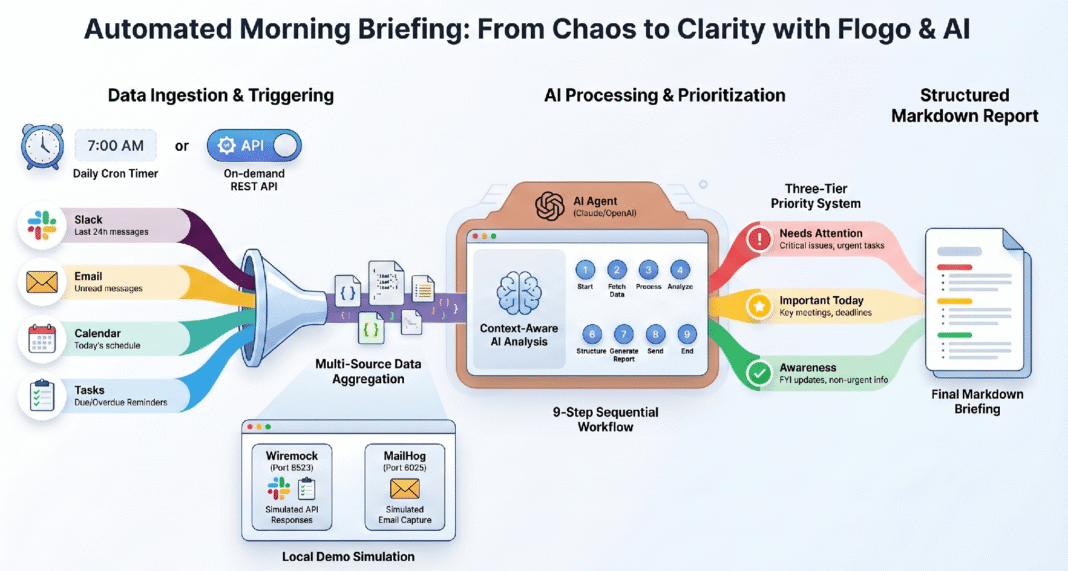
Instead of asking people to assemble their own picture of the day from four separate tools, the workflow does it for them — automatically, on a schedule or on demand. It gathers the same information a person would, but hands it to an AI model trained to separate the urgent from the merely present. The result is delivered as one structured briefing, ready the moment the day begins.
There is nothing for the employee to configure, query, or maintain. They simply receive clarity.
How It Works, at a Glance
The workflow runs in three straightforward phases. The technical machinery stays out of sight; what matters is the flow from raw noise to a finished briefing.
| Phase | What Happens | Business Value |
| 1 — Gather | Collects the day’s signals from Slack, email, calendar, and tasks. | Brings four fragmented sources into one place, with no manual checking. |
| 2 — Prioritize | An AI model reads everything and organizes it by what needs action. | Turns a raw pile of messages into a ranked, decision-ready summary. |
| 3 — Deliver | Produces one clean, structured briefing. | Gives each person a single source of truth to start the day. |
The briefing can arrive automatically first thing in the morning, or be requested on demand — whichever fits how a team already works.
Intelligent Prioritization: Three Tiers
The real value is not aggregation — it is judgment. Rather than returning a flat list, the AI sorts everything into three tiers designed to reduce cognitive load, so the eye lands on what matters first.
- 🔴 Needs Attention — Critical blockers, hard deadlines, and overdue items. The things that carry a cost if ignored today.
- 🟡 Important Today — Key meetings, replies that are expected, and time-sensitive preparation. The substance of the day.
- 🟢 Awareness — Background updates, low-priority notifications, and FYIs. Worth knowing, not worth acting on right now.
This structure is the point. A person can absorb a three-tier briefing in under a minute and know exactly where to spend the next hour.
A Day in the Life: A Sample Briefing
Here is what the TIBCO Flogo workflow produces on a typical morning — a single report, assembled from four sources, prioritized and ready to read:
## 🔴 Needs Attention
– @alice is blocked waiting for PR #342 review — EOD deadline
– ⚠️ Expense report is 2 days overdue
## 🟡 Important Today
– Architecture Review at 11:00 — prep by reading the API design doc in #platform
– 1:1 at 14:00 — update manager on Q2 OKR progress
– Q2 budget email from Alice needs a sign-off reply
## Today’s Schedule
| Time | Meeting | Type |
|——-|———————|———–|
| 09:30 | Daily Standup | Recurring |
| 11:00 | Architecture Review | Meeting |
| 14:00 | 1:1 with Manager | 1:1 |
## Today’s Tasks
– [ ] Review OKRs with team
– [ ] Send v2.3 release notes to stakeholders
– [ ] Call dentist
– [x] ⚠️ Submit Q2 expense report (OVERDUE 2 days)
## Unread Emails
– Alice — Q2 Budget Review: needs sign-off by EOD (needs reply)
## Slack Activity
– DM from Carol: wants 5 minutes before the architecture review — reply or decline
– #releases: v2.3 ready to ship tomorrow (FYI)
## 🟢 Awareness
– Platform maintenance tonight 22:00–23:00 UTC — no action needed
– Dave asked for the Q2 metrics spreadsheet — low priority
One glance and the day is clear: unblock Alice, chase the overdue expense report, prep for the 11:00 review, and reply to the budget email. Everything else can wait — and now you know that on purpose.
Why It Matters for the Enterprise
An AI Morning Briefing built with TIBCO Flogo is a small change with a compounding return:
- Reclaimed focus. People spend their first hour acting on priorities, not hunting for them.
- Fewer things slip. Overdue approvals, blocked colleagues, and expected replies are surfaced, not buried.
- Consistent prioritization. Every employee applies the same logic to their day, regardless of how organized their tools are.
- It scales. What helps one person helps an entire organization the same way, with no added effort per user.
- Built on a trusted foundation. The workflow runs on TIBCO Flogo, an enterprise integration platform, giving IT the governance, connectivity, and deployment control it expects — while remaining flexible on the AI model behind it (Anthropic’s Claude or OpenAI).
Connects to the Tools You Already Use
The briefing draws on the systems teams already live in — no new platform to adopt:
- Slack for team conversation and direct messages
- Microsoft Outlook for email
- Google Calendar for the day’s schedule
- Todoist (and similar) for tasks and reminders
It runs on a daily schedule or on demand, and connects through the enterprise-grade, secure authentication standards each of these services already provides.
From Chaos to Clarity
The morning scramble is so routine that most organizations have stopped seeing it as a problem. But the first hour of the day is also the most valuable — and it is being spent on reassembly instead of work. An AI Morning Briefing quietly gives that hour back: one report, prioritized, waiting when the day begins.
Want to see how it’s built or adapt it for your team? Explore the full project: Click here
Author:
Sanjeev Singh
Sanjeev Singh is a Principal Engineer at TIBCO with 20 years of software experience specializing in enterprise integration, stream processing, and scalable cloud data architecture. Armed with a Master’s in Data Science, his technical expertise spans Flogo, BusinessWorks, EMS and other TIBCO products , alongside building custom Model Context Protocol (MCP) servers and advanced LLM implementations.