

TIBCO Streaming is an enterprise-grade platform for real-time streaming analytics.
Users integrate and leverage machine learning models within TIBCO Streaming primarily for real-time, adaptive analytics and decision-making on streaming data.
TIBCO Streaming provides robust capabilities for integrating and operationalizing ML models directly within the real-time data pipelines. This integration allows for immediate decision-making and automated actions based on predictive insights derived from live data streams.
Model Management Service (MMS), an integral part of TIBCO Streaming, is a modern, cloud-friendly hub designed for enterprise-grade management and deployment of ML models and decision tables to AI-powered analytic applications running in Streaming Clusters.
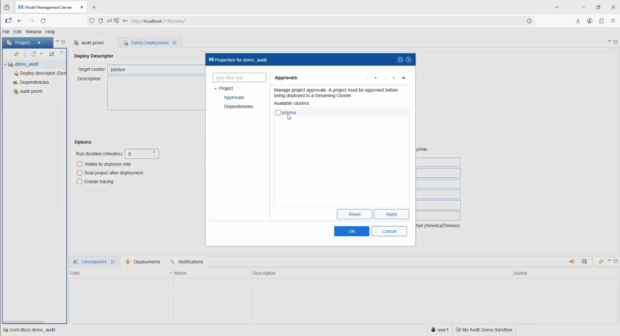
Capabilities:
- Flexible, decoupled management: MMS handles the lifecycle of ML models independently from streaming applications, allowing teams to manage models without impacting running processes.
- Governed model updates: Every edit and deployment goes through a controlled approval process, creating a single source of truth and maintaining model integrity across the organization.
- Zero-downtime hot deployment: Updates to models can be applied dynamically, ensuring streaming applications continue running without interruption, providing continuous, reliable operations.
Value driven by MMS
TIBCO Streaming and the Model Management Server streamline the process for data scientists to move models from development into production and manage them at scale.
- Operationalizing Models in Real-Time: Data scientists can build models (using Python, R, or PMML) and use the Model Management Server to deploy these models directly into TIBCO Streaming applications. This enables the models to perform real-time scoring and generate immediate actions or alerts on live, high-speed data streams (e.g., for fraud detection or predictive maintenance), rather than relying on batch processing of historical data.
- Model Lifecycle Management and Governance: The Model Management Server acts as a central repository for versioning models and managing their metadata. This provides essential governance, auditing, and compliance features (e.g., electronic signatures, access controls, and approval workflows) necessary for regulatory environments.
- Collaboration: The platform offers a collaborative environment where data scientists, data engineers, and business stakeholders can work together, track changes, and manage projects across the entire ML lifecycle.
- Monitoring and Retraining: Data scientists can monitor the performance and accuracy of deployed models in production. If a model’s performance degrades (model drift), the system facilitates the process of retraining and seamlessly deploying a new version.
- Scalable Deployment: The integrated system allows models to be deployed in highly available, high-performance streaming clusters, enabling data scientists to scale their analytical solutions to handle massive data volumes without worrying about the underlying infrastructure complexities.
- Flexibility: It supports models from various authoring platforms (e.g., PMML, Python, R, H2O, TensorFlow, StreamBase Decision Tables), allowing data scientists to use their preferred tools, and integrate them into the TIBCO ecosystem for deployment, leveraging a wide range of pre-built connectors to various data sources and cloud environments
In conclusion, TIBCO Streaming and the Model Management Server together, help Data Scientists and IT teams to operationalize ML models by bridging the gap between model development and production deployment (MLOps).
MMS is available in TIBCO Streaming 11.2.0.
About the Author
Prajakta Tanksale is a Principal Product Manager for TIBCO Event Processing, TIBCO Streaming, and the TIBCO Fulfilment Orchestration Suite. With over nineteen years of distinguished experience at TIBCO, she has held multiple roles that reflect her comprehensive expertise in product management. She is responsible for defining product strategy and executing the roadmap, collaborating effectively with cross-functional teams, customers and partners to drive innovation and achieve strategic objectives.


