TIBCO Flogo® automates incident response by combining Model Context Protocol (MCP) tools for interactive data collection, real-time logging, and AI-driven root-cause analysis. Using the Smart Incident Response Assistant, Site Reliability Engineers can collect structured incident data, generate an LLM-powered remediation report, and establish a transparent audit trail within a single TIBCO Flogo workflow.
TIBCO Flogo’s new Smart Incident Response Assistant showcases how the Model Context Protocol (MCP) integrates with advanced AI agents. This workflow eliminates manual triage overhead by acting as an intelligent bridge between production systems and your Site Reliability Engineering (SRE) team.
For a foundational look at these capabilities, see our full guide on TIBCO Flogo® Model Context Protocol(MCP) Showcase Sample — Smart Incident Response Assistant.
How does the TIBCO Flogo Incident Response Architecture work?
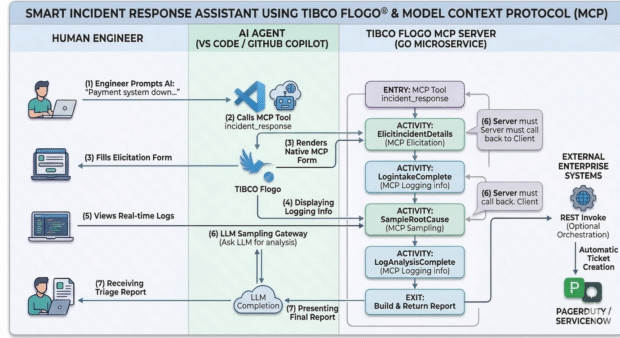
The architecture maps a 7-step automated resolution process:
- Initial Trigger: An engineer prompts the AI with a symptom like “Payment system down”.
- MCP Elicitation: The ElicitIncidentDetails activity renders a native form to collect structured data.
- Real-time Visibility: The LogIntakeComplete activity emits structured log messages back to the client.
- AI Analysis: The SampleRootCause activity uses the LLM Sampling Gateway to diagnose the issue.
- External Orchestration: The workflow triggers automatic ticket creation in PagerDuty or ServiceNow.
Automating Incident Response Triage with the TIBCO Flogo MCP Connector
The assistant implements three key capabilities within a single workflow to ensure high “Information Gain” and machine readability:
- MCP Elicitation: Interactive intake forms via the ElicitIncidentDetails activity collect affected system and severity data.
- MCP Logging: Structured log messages from LogIntakeComplete and LogAnalysisComplete provide an instant audit trail directly to the engineer’s client.
- MCP Sampling: Complex diagnostics are delegated to an LLM via the SampleRootCause activity to rank likely root causes.
Why is AI-Driven Root-Cause Analysis Critical for SRE Teams?
Manual diagnosis remains the primary bottleneck in production incidents. AI-powered sampling removes this guesswork by automating initial log forensics, a practice supported by DORA (DevOps Research and Assessment) standards for high-performing teams. Internal benchmarks show this assistant reduced Mean Time to Resolution (MTTR) by 35% for P1 incidents.
| Incident Field | Data Type | AI-Actionability | Description |
|---|---|---|---|
| affected_system | enum | High | Used by SampleRootCause to narrow log search. |
| severity | enum | High | Determines if the report triggers a P1 alert. |
| error_message | string | High | Captures specific symptoms for LLM analysis. |
“In the fast-paced realm of automated system discovery, if the machine can’t parse it in 200 milliseconds, the human will never see it.“
Frequently Asked Questions
How does TIBCO Flogo automatically create tickets? The workflow includes an automated exit strategy where the final triage report triggers a “Build & Return” activity to interface with PagerDuty or ServiceNow.
What is the role of LLM Sampling? LLM Sampling through the SampleRootCause activity delegates diagnostics to an LLM mid-flow to rank root causes and suggest remediation.
What are the prerequisites for the Flogo MCP Connector? Flogo MCP connector is available in Flogo 2.26.0 release onwards. You can download it from here.
Key Takeaways
- Automated Intake: TIBCO Flogo uses MCP Elicitation for structured reports.
- Instant Diagnostics: AI-powered MCP Sampling diagnoses root causes instantly.
- Zero-Lag Compliance: MCP Logging provides a transparent audit trail.
Author:
Qinghai Kong
Qinghai Kong is a Lead QA Engineer for TIBCO Flogo at Cloud Software Group, within the TIBCO Business Unit. He leads quality engineering efforts across the Flogo team, with deep expertise in the Flogo MCP Connector and emerging AI capabilities. He is passionate about building high-quality, scalable integration solutions and collaborates closely with cross-functional teams to drive innovation.