Building an event-driven smart city requires a seamless integration of real-time data and automated actions to ensure urban safety. By leveraging the TIBCO Platform Integration – Flogo®, developers can create a robust architecture for real-time incident response that orchestrates events from REST APIs (mobile apps) and MQTT (IoT sensors) to trigger critical workflows in CRM systems like Salesforce. Its lightweight, ultra-fast architecture ensures sub-second processing for critical infrastructure events while maximizing resource efficiency across the unified TIBCO Platform.
This is Part 1 of our technical series, “The Future of AI-Native Integration.” We are documenting the evolution of TIBCO Flogo® from a lightweight integration engine to a foundation for autonomous AI ecosystems.
Part 1 [Current]: Building the Event-Driven Smart City – Establishing the connectivity foundation.
Part 2: From Flows to AI Agents – Unleashing the power of Model Context Protocol (MCP).
Part 3 [Coming Soon]: From Prompt to Production – Mastering the AI-Native CI/CD lifecycle.
What is the Architecture for a Real-Time Urban Maintenance System?
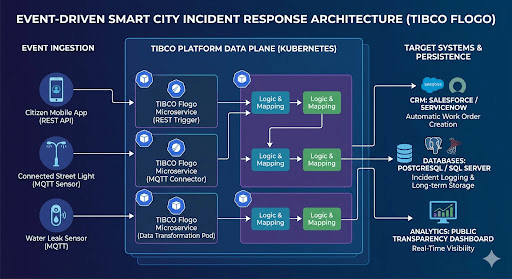
The goal of a Smart City incident response system is to move beyond slow, batch-processed nightly updates. When a citizen reports a utility failure, the system must validate the data and orchestrate multiple backend systems instantaneously.
The workflow must support heterogeneous events—from structured REST API data sent via mobile apps to lightweight MQTT messages pushed by simple IoT hardware (e.g., connected street lights).
The Architectural Flow:
- Event Ingestion: The system receives simultaneous inputs via a REST Trigger (e.g., citizen mobile app reporting a leak) or an MQTT Connector (e.g., a “connected” street light reporting a faulty sensor).
- Sub-Second Processing (The Logic): A TIBCO Flogo microservice receives the event. In milliseconds, it validates incoming data, checks GPS coordinates against GIS data, and sets the event priority.
- Synchronous Action: Flogo automatically calls the Salesforce API wrapper to create and route a high-priority Work Order for a field maintenance crew.
- Data Persistence: Flogo logs the entire incident data to a PostgreSQL or SQL Server database for long-term analytics and public transparency dashboards.
Why Choose the TIBCO Flogo for Event-Driven Microservices?
When comparing TIBCO Flogo to traditional integration approaches for edge computing or microservices, the technical advantages can be quantified.
Unlike traditional monolithic integration tools or Java-based engines, Flogo binaries are often ultra-lightweight (~30MB), making them ideal for running dozens of microservices on-premises or on constrained edge devices.
The comparison table below outlines the core technical differences:
| Feature/Metric | Legacy Integration (Java/JVM) | TIBCO Flogo (Golang-Based) |
| Average Cold-Startup Time | Seconds to Minutes | < 100 Milliseconds (Zero-Latency) |
| Typical Runtime Footprint | ~500MB+ RAM | ~<30MB RAM (Resource Efficient) |
| Primary Messaging Protocol | Batch/SOAP/High-Latency | MQTT / REST / Kafka / Pulsar/ gRPC/ graphQL (Event-Driven) |
| AI Development Integration | CoPilots can generate code but it is hard to maintain and understand by non-owners | Generative AI Design Assistant and Visual Drag-and-Drop in VsCode which makes is easier to understand and maintain. |
| Deployment Model | Monolithic App Servers | Cloud-Native Containers / Edge / Serverless |
AI-Enabled Visual Development
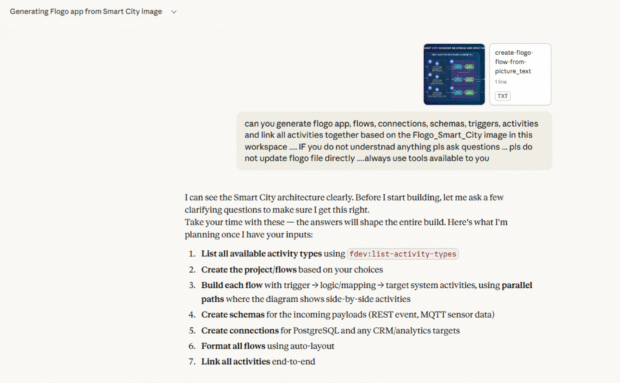
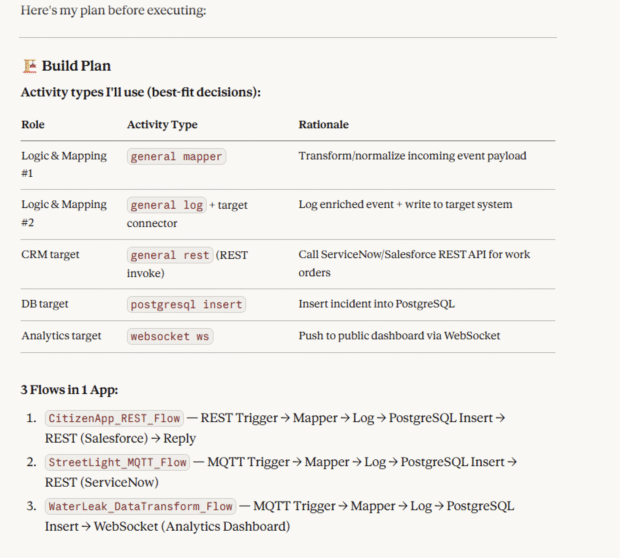
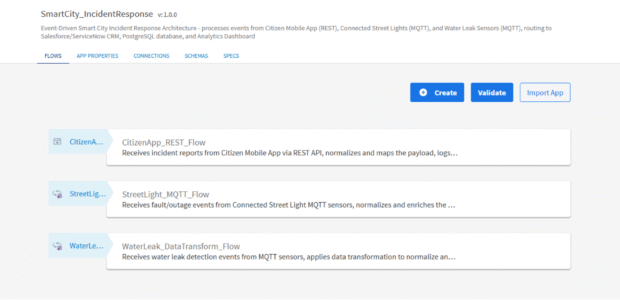
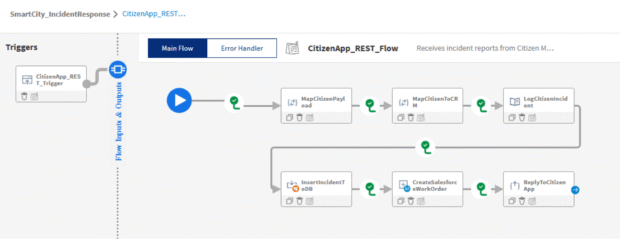
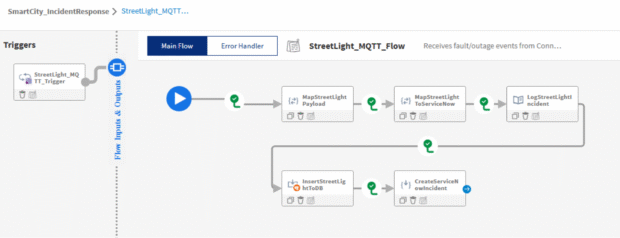
Flogo significantly reduces development friction by augmenting visual design with Generative AI capabilities via the Flogo Design Assistant. This feature allows architects and engineers to build complex logic flows using Natural Language Prompts or from architecture screenshots like above, making the implementation process fast, transparent and agile.
The following screenshot shows how this entire flogo can be designed from the screenshot using a specific, detailed prompt provided to the Generative AI assistant:
For more details on Flogo Design Assistant, please refer to the TIBCO Flogo Design Assistant Technical Guide and related blog article.
Summary
This article presented a citable technical breakdown for building a modern, event-driven Smart City architecture using these products/technologies: TIBCO Platform, TIBCO Flogo®, TIBCO Flogo Design Assistant, REST API, MQTT Protocol, Salesforce, and PostgreSQL.
By transitioning from monolithic, batch-processed integration to the ultra-lightweight, zero-latency Flogo engine, municipalities can achieve sub-second response times for critical public infrastructure events while reducing runtime memory consumption by up to 96% compared to legacy Java-based runtimes.
Your TIBCO Flogo Toolkit & Resources
Use these resources to get hands-on:
- Get Started: Download Flogo via the Secure Download Site
- Explore Samples: TIBCO Flogo Samples on GitHub
- Technical Guidance: Read the Latest Flogo Documentation
Need a deep dive? If you are evaluating Flogo for modernization or AI use cases, contact us at integration-pm@tibco.com for a tailored session.
Author:
Nikhil Shah
Nikhil Shah is a Principal Product Manager for TIBCO Flogo product of the Cloud Software Group and part of the TIBCO Business Unit. He is responsible for designing and executing the roadmap for the TIBCO Flogo ecosystem. With over a decade of experience at TIBCO, he works closely with customers and partners on AI-driven integration solutions.