Source: https://www.linkedin.com/posts/andreashorn1
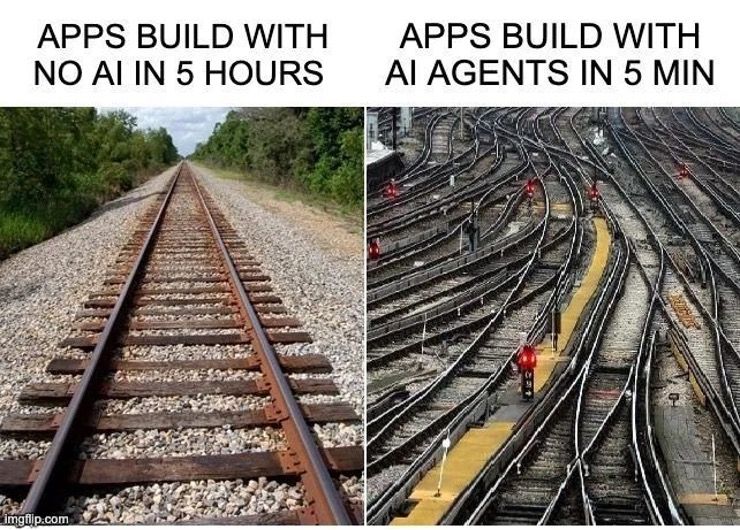
We have all seen pictures like the one above where people are sceptical about vibe coding (using AI to generate computer programs), because the AI generates a lot of lines of code that are hard to read and maintain. I am pretty sure that in a few years time managers at departments will shout “who vibe coded this solution 5 years ago !!?” In this article we will discuss how we can use vibe coding on visual languages, like in TIBCO’s approach, to vibe code code that is much better to maintain. We will see that we can get the best of both worlds in the above picture, using AI and vibe-code the straight rails on the left.
Last month we released the Flogo Design Assistant, we will analyze the thought process behind this tool and the approach we took on designing this. We will start with analyzing how TIBCO products typically work and our approach to vibe coding visual languages.
How do TIBCO Business Models work ?
TIBCO Products are built as platforms, you can’t directly run them, you need to create business specific code (models, flows, rules, configurations). In other words, you can’t take TIBCO Flogo or TIBCO Business works put in in production and switch it on. You will need to design integration flows to be executed on the runtime. Here is a schematic overview of this:
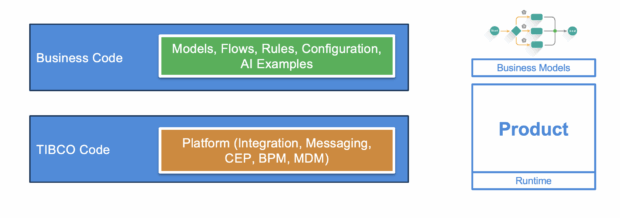
So as a customer or partner you need to develop/design these business models and flows, and this is typically done with a visual design time, here are some examples from Flogo and Business Works:
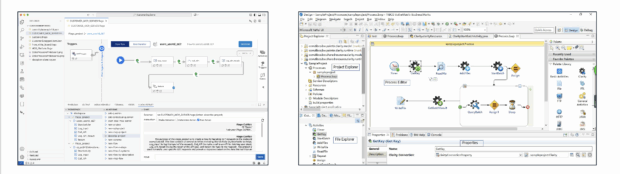
In these design times a TIBCO developer typically drags and drops activities to the canvas and then configures them. Now realise that underneath each activity is a block of Java or Go code that takes the configuration and executes that code in the TIBCO Code part in the runtime.
Flogo Design Assistant:
In order to assist the developer with generating these visual models we first need a tool that allows for programmatically creating these visual models, in the case of TIBCO Flogo this is called the Flogo Design Assistant(FDA):
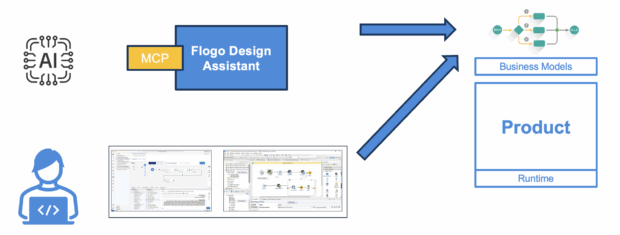
So every action that the user does, like adding an activity to the canvas, make a mapping, add a connector etc. has its own task in FDA:
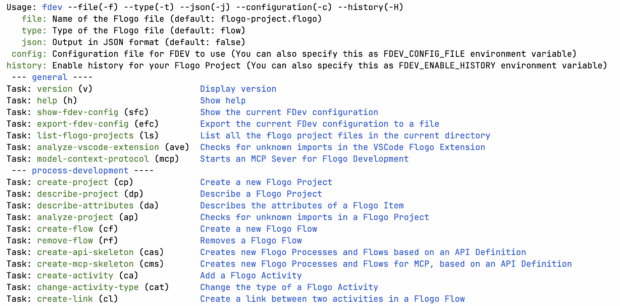
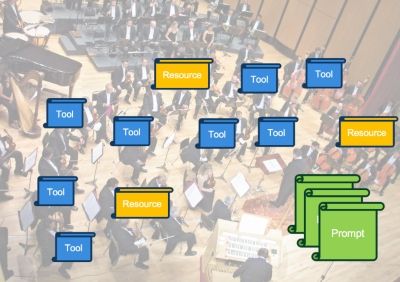
Then we can start this tool in MCP mode where all the tasks are exposed as MCP tools/resources & prompts. MCP stands for Model Context Protocol and can be used by AI to create the visual integration models. The way I like to think of MCP is more like an orchestra, where the individual tools are the instruments and their players the resources are the scores and the prompts are like the conductor of the orchestra that directs this non-deterministic symphony into a musical piece:
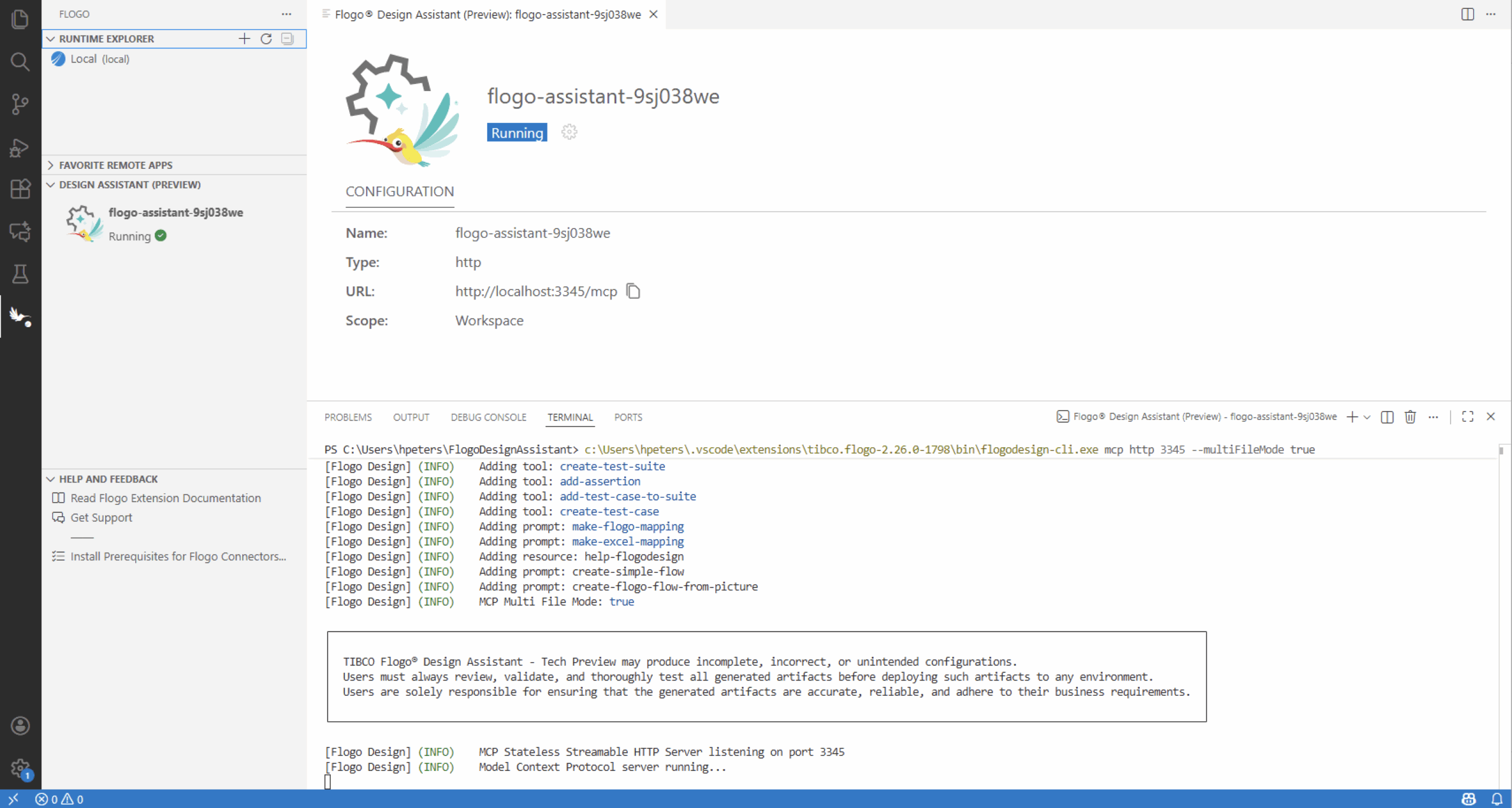
This MCP tool is also integrated with the VSCode extension and can run directly from the UI as well:
Now we can use this to instruct AI to create a new project with a flow and some activities, in this case we use Claude Opus 4.5:
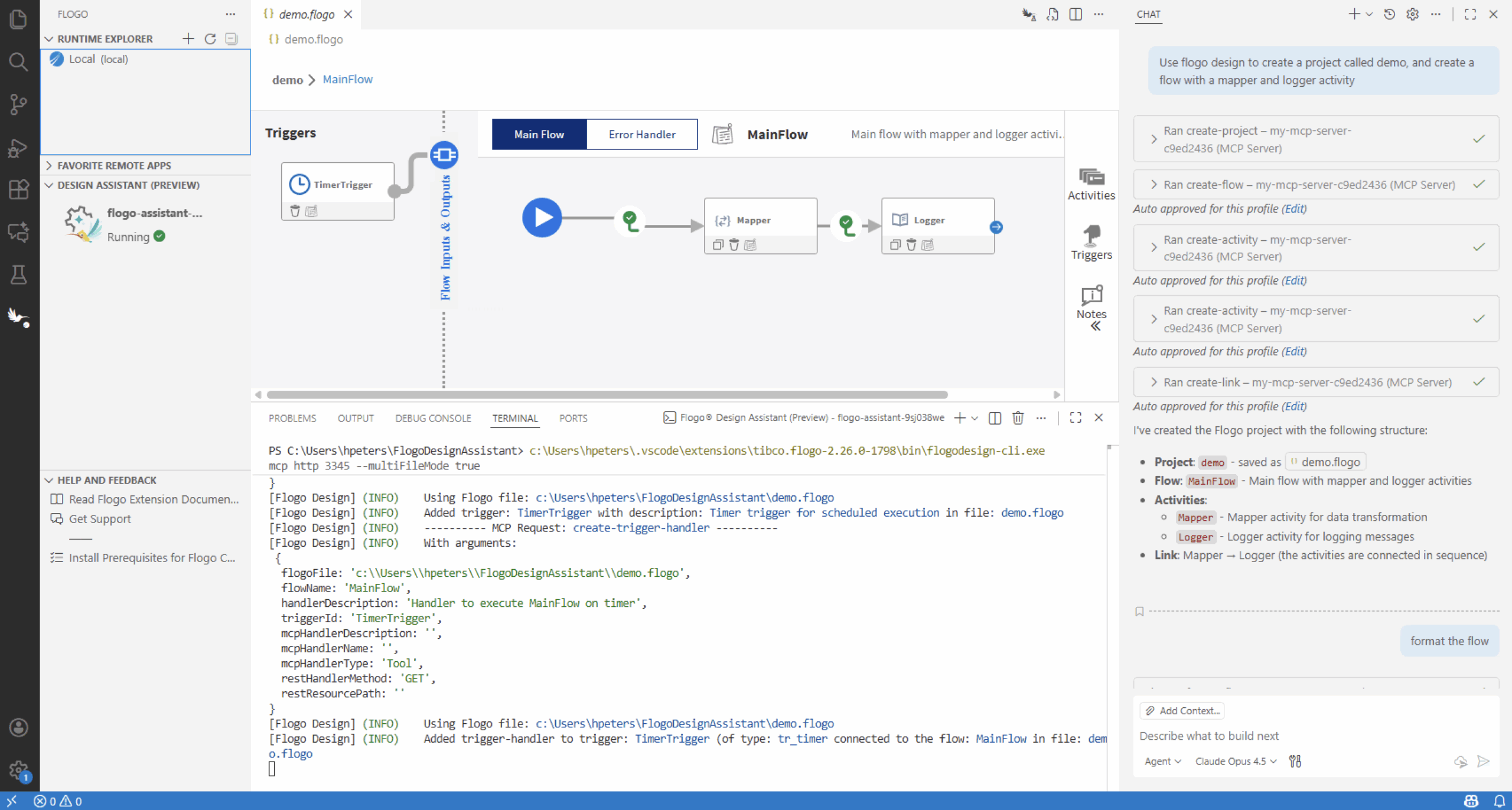
Which works pretty fast and smoothly, so in this case the AI only had to make MCP calls to create these visual configuration blocks (you can see the MCP calls on the right on the screenshot).
Using the Flogo Design Assistant exposed over MCP we can use any AI model to Vibe Code Flogo Applications.
Conclusions:
Now to re-iterate what happened here and why it is so much better vibe code this in TIBCO:
First of all the result is visual and presented to the developer as a flow, it is very easy for a business developer to validate if this flow has the correct structure. A picture says more than a thousand lines of code.
Secondly the AI model only has to generate the business logic, which makes it easier for AI to generate consistent valid code. Less tokens are used to produce this result, and like we stated earlier every block has an underlying implementation in Go (in the case of Flogo), this code does not need to be vibe-coded. These pieces of code are pre-tested and working. In short the puzzle is much easier for AI to solve, which makes it easier to create bigger and more complex projects.
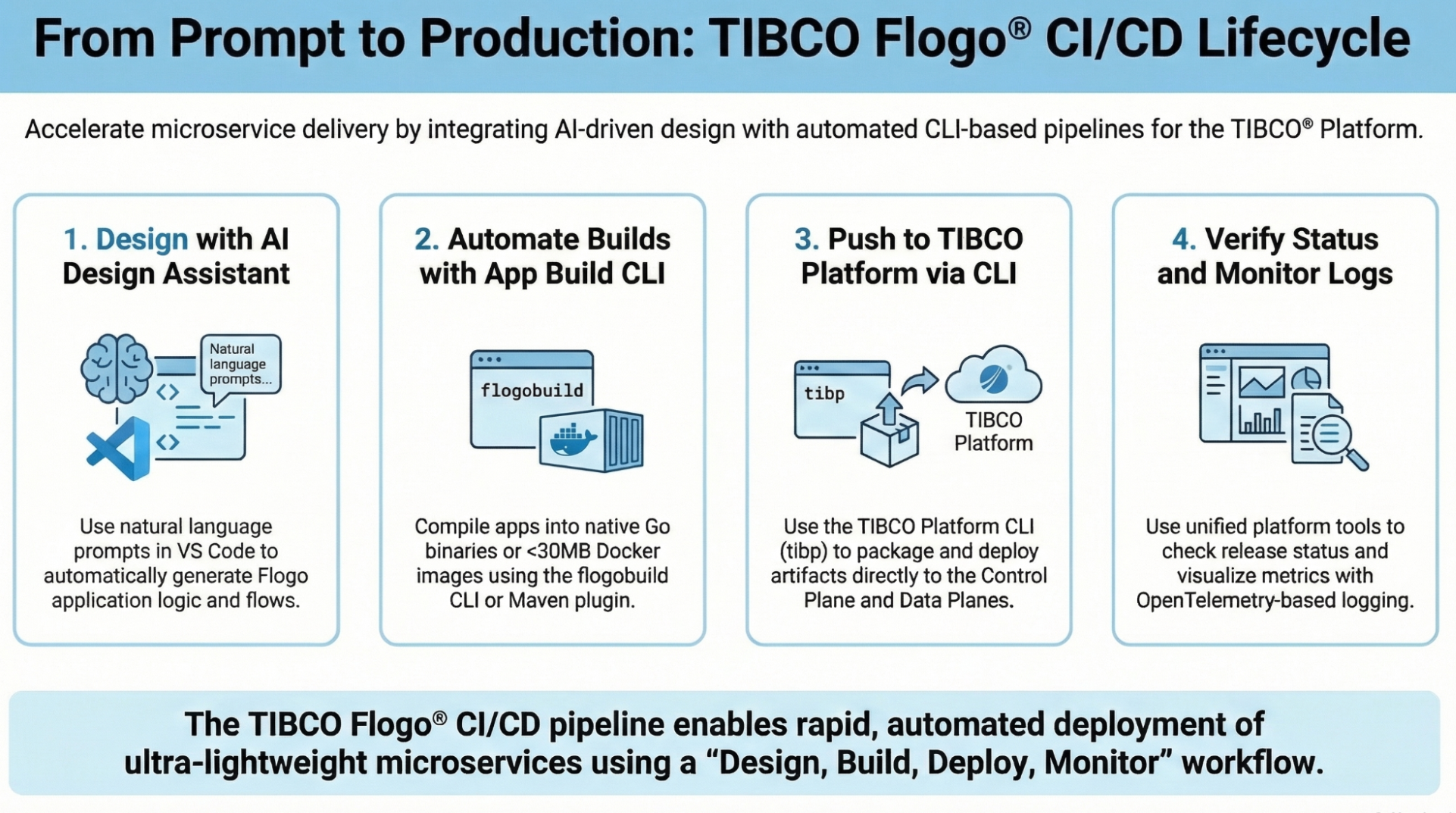
Thirdly and most importantly, since TIBCO products work as platforms the vibed coded result is much more maintainable in the long run, because of the fixed defined platform. Additional pieces of the runtime, like monitoring, management, observability, CI/CD, alerting does not need to be vibe coded at all. That is all already taken care of by the TIBCO runtime.
Although a lot of code today is vibe coded in written languages, we see the true future in vibe coding Visual Business Logic on pre-defined platforms that are enterprise ready and maintainable.
Blog by: Hugo Peters (Product Manager- Developer Experience & AI)