
The Recommendation Engine: Why Every Telco's Order Fulfillment Stack Needs One
The problem: too much catalog, not enough guidance
Telco catalogs have exploded in complexity. What used to be three or four voice/SMS plans is now hundreds of SKUs — converged plans, device bundles, IoT add-ons, enterprise tiers, promotional variants — often duplicated across brands and markets. Customers facing that much choice don't buy more confidently; they hesitate, abandon carts, or default to whatever a call center agent happens to remember to mention.
The industry's answer to this is a recommendation engine (RE): that surfaces the right next product at the moment of purchase — not as a follow-up email, but before the order gets placed.
Two flavors of this show up everywhere in telco commerce:
- Similar products — "more like this," based on a product, search term, or desired attributes.
- Complete-the-set — "frequently bought together," learned from real order history.
Why telco vendors specifically need this — not just e-commerce generally
Telco catalogs aren't flat retail SKUs. A "similar" plan isn't just one with similar-sounding marketing copy — it needs to match on data allowances, contract terms, device compatibility, and pricing tier. Generic e-commerce recommendation tools built for retail don't understand that structure out of the box. A telco-grade RE has to combine semantic similarity (what a product means) with structured attribute similarity (what a product actually is, technically and commercially) — otherwise you get recommendations that read well but bundle incompatible or nonsensical combinations.
This is also why it matters for revenue and cost, not just experience:
- Revenue — cross-sell learned from actual buying patterns beats static, hand-written rules.
- Cost — nobody can manually curate relationships across a catalog with thousands of SKUs across tenants.
- Speed — as 5G, IoT, and converged bundles keep growing the catalog, a learning system adapts; a rulebook needs constant rewrites
How TIBCO supports this
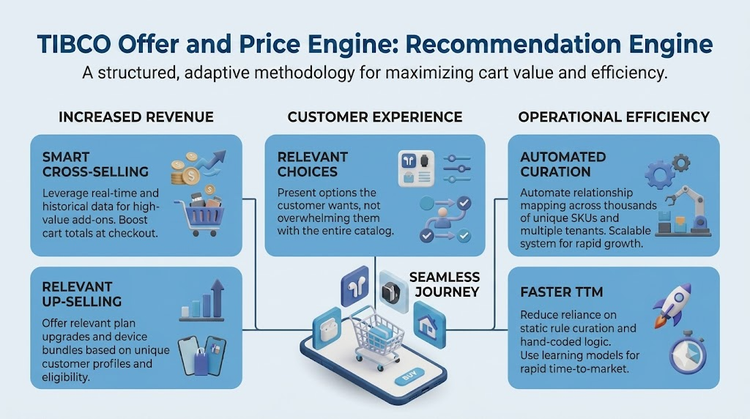
TIBCO's Offer and Price Engine (OPE) — the component of TIBCO Fulfillment Orchestration Suite, determines product eligibility for the subscriber and pricing for the offer. It is integrated with the product catalog provided by TIBCO Product and Service Catalog for product definition at design time. OPE already governs eligibility and pricing using rule models — for instance, blocking a device upgrade when a customer isn't eligible because it's been less than two years since their last purchase.
TIBCO's Recommendation Engine powered by TIBCO ActiveSpaces sits inside that same layer, closing the gap between "what's allowed" and "what's relevant." It works off two models learned from the tenant's own catalog and order history:
- Semantic concepts — products are embedded and clustered automatically based on the configured criteria, so similarity doesn't depend on manual tagging.
- Association rules — order history is mined to learn which product groupings tend to appear together in a basket, powering complete-the-set at checkout.
A characteristic-similarity layer on top lets the engine blend semantic closeness with structured attributes — price, data caps, technical specs — so results stay telco-relevant, not just textually similar. And it supports multi-tenany by design: every model, ingestion job, and query is scoped per tenant, which matters for operators and MVNOs running multiple brands off one platform. It plugs into the ingestion pipelines OPE customers already run — no parallel system to stand up.
Where this fits the broader market
TIBCO isn't alone — recommendation and next-best-offer capability has become close to table stakes across telco BSS platforms industry-wide. But the pattern that separates the ones that work from the ones that don't is consistent: recommendations only create value when they live inside the order and pricing flow itself, not in a separate marketing tool the customer never sees at the moment of decision. That's the design principle behind TIBCO's approach.
The value, in plain terms
- Higher conversion and basket size — relevant suggestions, not an overwhelming catalog dump
- Lower operating cost — no manual curation of a catalog that changes weekly
- Consistency across channels — one engine, every channel, same logic
- Built for real telco catalogs — technical and commercial attributes factored in, not just text
- Scales with complexity — true multi-tenancy for multi-brand, multi-market operators
The honest caveat: a recommendation engine is only as good as the order history and catalog data feeding it. Any vendor's claims — TIBCO's included — are worth validating against a live deployment, not a data sheet.
The bottom line
A decade ago, "does it bill correctly" was the question that separated serious order management platforms from the rest. Today, it's "does it know what to sell next — automatically, in the moment, at scale."
Catalogs will only get more complex. Customers will keep rewarding the operators who make choice easier, not the ones who offer the most options. The telcos that treat recommendation as core infrastructure — not a marketing add-on — are the ones who'll turn that complexity into revenue instead of churn.
The question isn't whether your order management platform needs this. It's whether you're building it in, or bolting it on.