
The 3-Second Mortgage: Autonomous AI Underwriting with Flogo and LLM
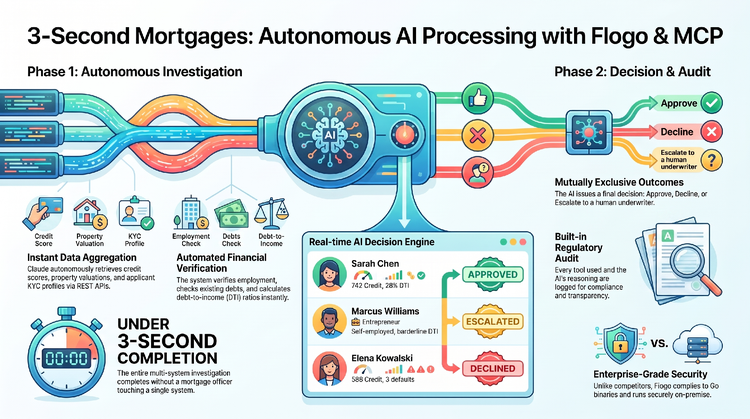
An autonomous underwriting workflow, built on TIBCO Flogo, that lets AI investigate, decide, and document a mortgage application in seconds — without data ever leaving the enterprise.
Key Takeaways
- The problem: Traditional mortgage underwriting takes 5–10 business days, costs $800–$1,200 for complex cases, and loses more than a third of applicants to wait times.
- The solution: An autonomous workflow where Claude AI investigates each application across credit, property, income, and debt — then returns a compliant decision in seconds, not days.
- The outcomes: Every application ends in one of three clear results — ✅ Approve, ⚠️ Escalate to a human underwriter, or ❌ Decline — each with a written rationale.
- The safeguard: The AI never touches enterprise systems directly. Every action runs through governed TIBCO Flogo tools, on-premises, with zero data egress and a full audit trail.
- The payoff: Roughly 70% less manual underwriting effort, a cost-per-decision measured in single-digit dollars, and consistent, regulator-ready decisions at scale.
The Problem: Underwriting That Can't Keep Up
Getting a mortgage decision is slow — and expensive for everyone involved. A single application moves through manual credit checks, property valuations, affordability assessments, and compliance reviews, each handled by a different specialist team working in a different system.
The result is a process measured in days, not minutes:
- 5–10 business days for a typical decision.
- $800–$1,200 per application for complex cases.
- 38% of applicants abandon the process before it finishes, discouraged by the wait.
For a lender, this is more than an inconvenience. It is lost revenue, an underwriting team buried in routine cases, and a customer experience that competitors can beat on speed alone.
The Solution: An AI That Investigates and Decides
Instead of routing an application through a chain of teams, the workflow hands the investigation to an AI agent. Claude decides what it needs to know, pulls credit history, property valuation, employment, and existing-debt data, calculates affordability, and weighs it all against the lender's policy — then commits to a single, documented decision.
Crucially, this is not the AI acting alone in a black box. Every piece of data it sees, and every action it takes, flows through governed enterprise tools built on TIBCO Flogo. The lender stays in control of the data, the rules, and the record.
How It Works, at a Glance
The workflow runs in two phases, mirroring how a human team would work — investigate first, then decide and document.
| Phase | What Happens | Business Value |
| 1 — Autonomous Investigation | The AI gathers credit score, property valuation, employment, existing debts, and KYC profile, then calculates the debt-to-income ratio. | The full, multi-system investigation completes in seconds — with no officer manually checking each system. |
| 2 — Decision & Audit | The AI issues one final outcome — Approve, Escalate, or Decline — and every tool it used and every reason it gave is logged automatically. | A fast, consistent decision paired with a complete, regulator-ready audit trail. |
The entire investigation completes without a mortgage officer touching a single system — routine applications resolve themselves, and only the cases that genuinely need human judgment reach a person.
Three Clear Outcomes
Every application ends in exactly one of three mutually exclusive results — no ambiguity, no half-decisions:
- ✅ Approve — The application clears policy on credit, affordability, and collateral. The AI records the approval and the recommended terms.
- ⚠️ Escalate to a Human Underwriter — Borderline or complex cases are routed to an underwriter with a pre-populated case file, so the human starts with the full picture instead of a blank form.
- ❌ Decline — The application fails policy on clear, documented grounds. The AI records specific, defensible reasons.
This structure is the point: it turns a sprawling, subjective review into a fast, rule-bound decision — while reserving human expertise for the cases that truly deserve it.
A Day in the Life: Three Decisions in Seconds
Here is how the workflow handles three very different applicants — each resolved in seconds, each fully documented:
Sarah Chen — ✅ Approved
A strong, first-time-buyer profile: a credit score of 742, debt-to-income around 28%, and several years of stable permanent employment. Every factor clears policy comfortably. *Decision: approve, with recommended terms — in seconds.*
Marcus Williams — ⚠️ Escalated
A self-employed applicant with borderline affordability. Individually, each factor is acceptable; together they warrant human judgment. Rather than guess, the AI escalates the case to an underwriter — complete with a summary and the specific documents to request. *Decision: escalate, with the groundwork already done.*
Elena Kowalski — ❌ Declined
A high-risk profile: a sub-600 credit score, debt-to-income near 58%, and multiple prior defaults. The application fails several policy limits at once. *Decision: decline, with clear, regulator-ready reasons.*
The lesson is not that AI replaces underwriters — it is that AI clears the routine, flags the genuinely difficult, and hands humans the hard cases already prepared.
Why It Matters for the Enterprise
Autonomous underwriting changes the economics of lending:
- Speed becomes a competitive advantage. Decisions in seconds instead of days mean fewer abandoned applications and a materially better customer experience.
- Dramatically lower cost per decision. AI-assisted decisions cost a fraction of manual underwriting, turning a $800–$1,200 process into single-digit dollars for routine cases.
- Underwriters focus on judgment. Roughly 70% of routine workload is handled autonomously, freeing specialists for the complex cases that need them.
- Consistency at scale. The same policy is applied to every application, every time — no reviewer-to-reviewer variation.
Governance, Security, and Compliance — By Design
For a regulated lender, trust is not a feature to bolt on later. It is built into how the solution works:
- The AI never connects to your systems directly. Every data access and every action goes through a named, governed TIBCO Flogo tool. The AI sees only what those tools choose to return.
- Your data stays on-premises. The solution runs inside your firewall with zero data egress — sensitive applicant information never leaves the enterprise.
- Every decision is auditable. The tools used, the data considered, and the AI's full reasoning are logged automatically for each application, supporting mortgage record-keeping obligations.
- Policy is enforced, not suggested. Lending rules are applied on every decision, so compliance does not depend on an individual reviewer remembering them.
Built for the Enterprise Stack
The processor connects to the systems a lender already runs — credit bureaus, property valuation services, employment verification, core applicant databases, CRM (such as Salesforce), and enterprise messaging for human hand-offs. Built on TIBCO Flogo and compiled to a lightweight native binary, it deploys on-premises or on the TIBCO Platform, giving IT the control, portability, and performance it expects.
It also stands apart from general-purpose automation tools: Flogo runs as a native, on-premises binary with a built-in ability to expose enterprise operations as AI-callable tools — rather than routing sensitive financial data through cloud-first platforms.
From Days to Seconds
Mortgage underwriting has long been a bottleneck that lenders simply accepted — too complex, too regulated, too risky to rush. Autonomous AI, governed by an enterprise integration layer, changes that calculation. The routine resolves itself in seconds, the difficult reaches a well-prepared human, and every decision arrives with its reasoning already on the record.
Want to see how it's built or adapt it for your institution? Explore the full project:
https://github.com/TIBCOSoftware/flogo-enterprise-hub/tree/master/samples/Agentic_AI/mortgagedemo